Inflatable Fishing Boats & Kayaks: Benefits, Types, and Why They're Worth It
When most people picture a fishing boat or kayak, they imagine something heavy, expensive, and requiring a trailer. Inflatable watercraft have changed that entirely. Today's inflatable fishing boats and kayaks are built with military-grade materials, deliver serious on-water performance, and pack down small enough to fit in the trunk of a car.
Whether you're a weekend angler, a casual paddler, or someone who wants versatile access to lakes, rivers, and coastal waters, inflatables offer a compelling case. Here's everything you need to know.
Why Choose an Inflatable Watercraft?
1. Portability & Storage
The single biggest advantage of an inflatable is how easy it is to transport and store. A full-size inflatable fishing boat can deflate and roll up into a bag you can carry over your shoulder. No trailer, no roof rack, no dedicated garage space required. For apartment dwellers, RV travelers, or anyone without a dock or storage facility, this is a game-changer.
2. Durability
Modern inflatables are made from heavy-duty PVC or Hypalon (CSM) fabric — the same materials used in military and rescue inflatables. They're puncture-resistant, UV-stabilized, and built to handle rocky shorelines, shallow rivers, and rough handling. The fear of popping an inflatable on the water is largely a myth with today's quality construction.
3. Affordability
Compared to hard-shell boats and rigid kayaks of similar size and capability, inflatables are significantly more affordable — both upfront and in ongoing costs. No trailer registration, no marina fees, and far lower maintenance requirements.
4. Versatility
Inflatables are not just for calm lakes. Many models are rated for Class III or IV whitewater, open coastal waters, and offshore fishing. The right inflatable can go places a rigid boat simply cannot — shallow flats, narrow river channels, and remote backcountry lakes accessible only by hiking.
5. Safety
Inflatables have multiple independent air chambers, meaning a single puncture will not sink the boat. They also sit higher in the water and have a wider, more stable beam than many comparable rigid craft, making them forgiving for beginners and safer in choppy conditions.
Inflatable Fishing Boats
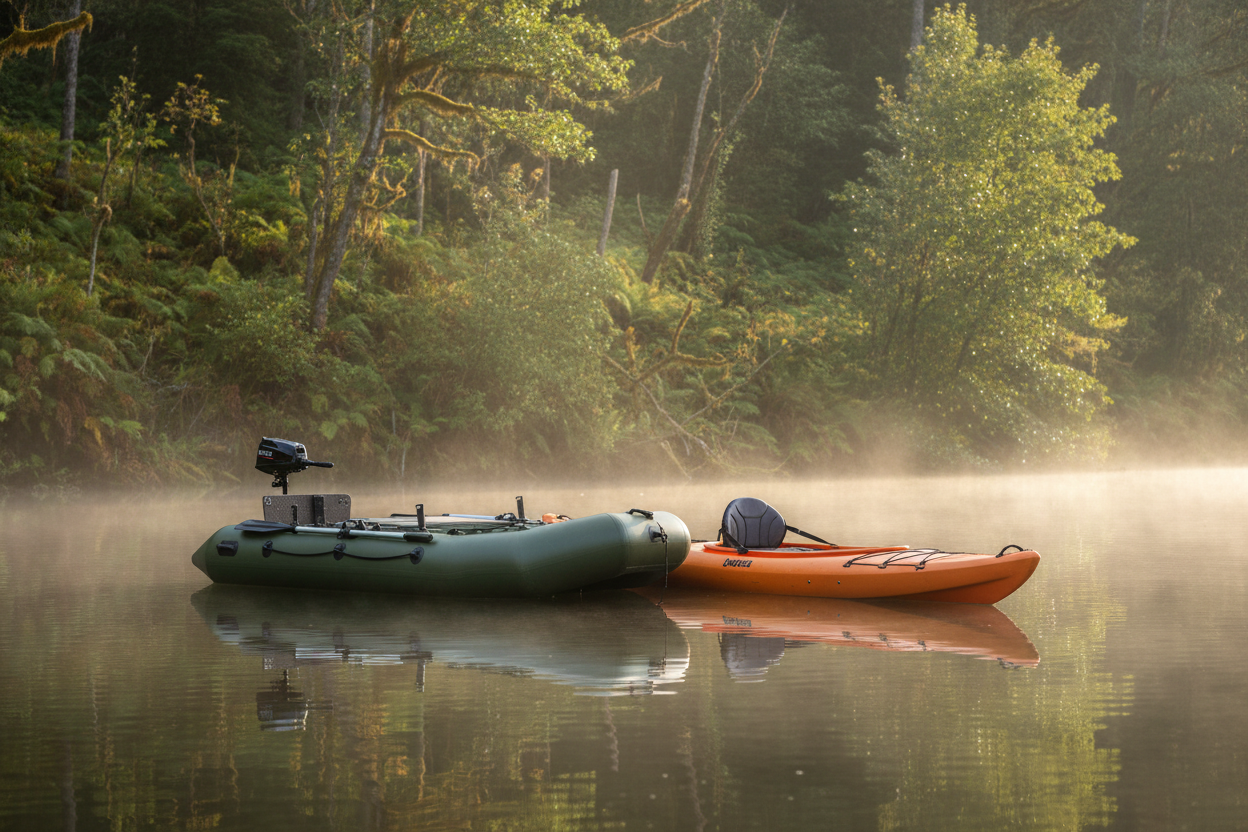
Inflatable fishing boats have evolved dramatically. Today's models come equipped with motor mounts, rod holders, gear storage, and high-pressure floors that rival the rigidity of fiberglass hulls.
Key Benefits for Anglers
- Access remote fishing spots — Pack your boat into backcountry lakes, beaver ponds, and tidal flats that are unreachable by trailered boats
- Quiet on the water — Inflatable hulls dampen sound and vibration, reducing fish-spooking noise
- Stable casting platform — Wide beam designs provide a stable, comfortable platform for standing or seated casting
- Motor-ready — Most inflatable fishing boats support electric trolling motors and small gas outboards (typically 2-10 HP)
- Easy solo launch — No ramp required; launch from any shoreline, dock, or beach
Types of Inflatable Fishing Boats
Inflatable Pontoon Boats — Two parallel tubes connected by a frame, offering exceptional stability and a low center of gravity. Ideal for solo anglers on rivers and lakes. Many models support a small motor and include rod holders and gear storage.
Inflatable Dinghies and Tenders — Compact, round-hulled boats that are highly portable and great for calm water fishing. Often used as tenders for larger vessels or for fishing in sheltered bays and inlets.
RIBs (Rigid Inflatable Boats) — Feature a rigid fiberglass or aluminum hull with inflatable tubes along the sides. RIBs offer the best of both worlds — the stability and speed of a rigid hull with the buoyancy and safety of inflatable tubes. Popular for offshore and coastal fishing.
Inflatable Kayak Fishing Boats — Wider, more stable versions of inflatable kayaks designed specifically for fishing, with rod holders, gear tracks, and anchor systems built in.
Inflatable Kayaks
Inflatable kayaks have become a serious alternative to hard-shell kayaks for recreational paddlers, touring enthusiasts, and whitewater adventurers alike.
Key Benefits
- No roof rack needed — Deflate, roll up, and toss in the back seat or trunk
- Beginner-friendly — Wider beam and higher volume make them more stable and forgiving than many hard-shell kayaks
- Comfortable for long paddles — Inflatable seats and cushioned floors reduce fatigue on extended trips
- Surprisingly fast — High-pressure drop-stitch floors and streamlined hulls allow modern inflatable kayaks to track and perform comparably to entry-level hard-shells
- Great for travel — Pack one in checked luggage and paddle anywhere in the world
Types of Inflatable Kayaks
Recreational Inflatable Kayaks — Designed for calm lakes, slow rivers, and casual paddling. Wide, stable, and easy to maneuver. Perfect for beginners and families.
Touring Inflatable Kayaks — Longer, narrower, and faster than recreational models. Built for covering distance on open water, coastal touring, and multi-day trips. Often feature dry storage compartments and spray skirts.
Whitewater Inflatable Kayaks — Also called duckies, these self-bailing kayaks are designed for river running and rapids. Highly maneuverable, extremely durable, and forgiving for paddlers learning to read whitewater.
Inflatable Fishing Kayaks — Wider and more stable than touring models, with integrated rod holders, gear mounts, and anchor trolleys. Ideal for anglers who want a low-profile, quiet approach on the water.
Tandem Inflatable Kayaks — Two-person kayaks that can often be configured as a solo boat as well. Great for couples, parent-child paddling, or bringing a dog along.
Inflatable SUPs (Stand-Up Paddleboards)
While not a boat or kayak, inflatable stand-up paddleboards deserve a mention. iSUPs have become one of the fastest-growing watersports categories, offering a full-body workout, a stable fishing platform, and a fun way to explore calm water. High-pressure drop-stitch construction makes modern iSUPs nearly as rigid as epoxy boards, and they pack down to the size of a large backpack.
What to Look for When Buying an Inflatable
- Material — Look for heavy-duty PVC (at least 1000 denier) or Hypalon for maximum durability and UV resistance
- Number of air chambers — More chambers means more safety. A minimum of three independent chambers is recommended for fishing boats
- Floor type — High-pressure drop-stitch floors provide the most rigidity and performance; inflatable I-beam floors are softer but lighter
- Weight capacity — Always choose a boat rated well above your expected load (paddler plus gear plus fish)
- Pump included — A quality high-volume pump makes inflation fast and easy; electric pumps are worth the investment for larger boats
- Warranty — Reputable brands back their inflatables with multi-year warranties
Final Thoughts
Inflatable watercraft have earned their place alongside traditional hard-shell boats and kayaks. They are no longer a compromise — they are a genuinely smart choice for anglers, paddlers, and outdoor enthusiasts who value portability, versatility, and value.
Whether you are chasing bass on a remote mountain lake, running a river with friends, or simply looking for an easy way to get on the water without the hassle of a trailer, there is an inflatable built for the job.
Browse our selection of inflatable watercraft and find the right boat, kayak, or paddleboard for your next adventure.